
What you’ll learn
-
To prevent and respond to harassment in real time, we must be on the same page about what it looks like and it’s impacts.
-
Proactive tips to prevent and respond to harassment in real time that gives victims a voice and a choice - without demonizing the person who has harmed.
-
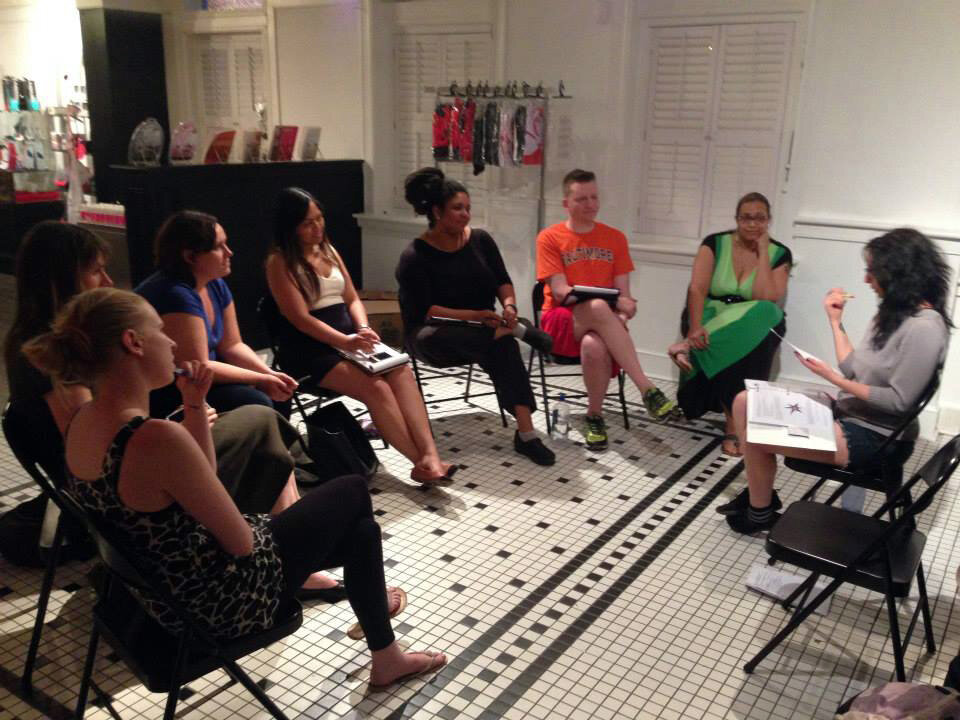
There’s a lot you can do to prevent harassment in your space before anyone even shows up! With an emphasis on easy and/or free actions to take, this course makes it simple for you.
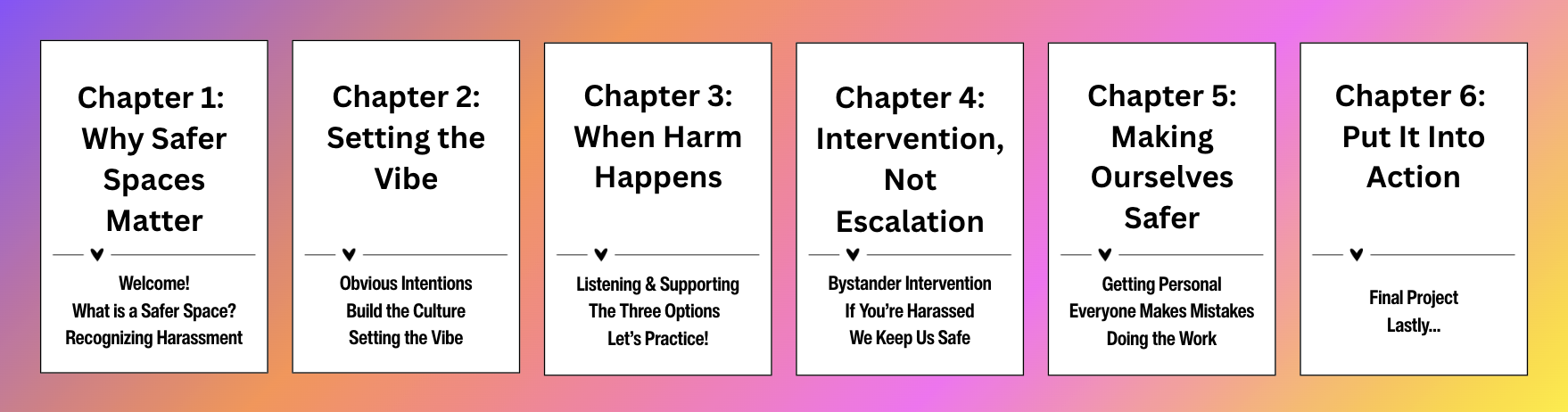
Course Map
Course FAQ
-
Individuals, workers, managers, bosses, teachers, students, group leaders, people with authority, customers, neighbors, community members, musicians, artists, anyone in customer service, hospitality or the service industry, collectives - in short, EVERYONE!
-
It’s not our goal to upset anyone taking this course. The goal is to learn good information you can use right away and easily share with others. We like to keep the vibe light, but we are still talking about harassment and violence and sometimes need to get specific so we’re all on the same page.
This course includes discussions of harassment and violence and may be triggering for individuals who have experienced it personally or know someone who has. Please take care of yourself as you engage. If at any point you feel overwhelmed, it’s okay to pause, seek support, or step away. Your well-being matters. We’ve also included a few options to help you create a self-care plan at the end of Lesson 2: Recognizing Harassment.
-
It is! But people have different learning styles, time availability, and budgets. The book Making Spaces Safer is based on the Safer Space Program and answers every question that has ever come up (so far!) in a training, in-person or virtual. It’s $15, available in e-book and audio format, and in Spanish.
A training costs a bit more, but you get a chance to learn with your co-workers in real time with Shawna as your guide, who can answer any question or address any concern unique to your space.
This course is self-paced, only $50 for individuals, with interactive elements like videos, quizzes, and reflective journal prompts. So truly, enjoy the option that works best for you!
-
This program’s foundational focus is gender-based violence, but highly adaptable to address harassment and violence based on other marginalized identities. Race, disability, sexual orientation, immigration status (and so many more!) are all inextricably tied to gender, which is often ignored or dismissed in larger conversations about oppression.
Many anti-violence programs are about prevention, or what to do when things have already escalated beyond your ability to safely intervene. While important, this program will help address gaps in these programs with practical, no-nonsense tools and guidance.
-
Not exactly. We believe “the work” is never done. There’s always more to learn, ways to grow, new research, as well as changing social dynamics to be considered.
This course explains the Safer Spaces Program essentials (preventative measures, victim-centered responses, etc) with enough detail that you can immediately use these skills and craft your own policies. It also introduces other important ideas to help support your safer spaces efforts (de-escalation, interpersonal skills, apologies, flirting, accountability, etc), each of which could be their own course. We hope upon completion, we make it easier for you to figure out where your gaps are so you can work towards filling them. Each section has additional resources and suggestions so you can find out more from other experts.
We hope the idea that there is no finish line will actually relieve some pressure! The goal is to always do a little better, which is much more realistic than being perfect.
-
Maybe! But maybe not. We encourage you to take the basic lessons and ideas and apply them to your specific circumstances. Consider all the information in this course as an offering. It’s up to you to make the most of it.
-
Well we certainly think so, but admittedly yes, some of the lessons are shorter than others. Guided self-reflection is an important element of this course so we hope that if you get through a lesson quickly, you’ll spend your extra time on the Reflective Questions and/or digging into the Additional Resources (videos, articles, book suggestions, etc) that we’ve provided.
Based on early feedback, each lesson averages between 15 and 30 minutes, depending on how much “homework” or self-reflection you do. The second half of the course has a lot of information packed into it, so leave yourself plenty of time as you finish the course to let it all sink in.
-
This course was designed to be taken on a computer or tablet. It’s possible to use your phone, but you might experience weird spacing issues or some out of order elements, which could make it confusing to follow. Feel free to use your phone to show the course to others or find a specific resource again.
-
Click this sentence right here and it will take you to the purchase page. Or, you can preview the “Welcome” page below and if you like it, click the Learn More button (at the top or bottom) and it will take you to the purchase page. If you have any trouble just use the Contact page at the top of the website to get in touch and we’ll be happy to help!
Meet your instructors
✳
Meet your instructors ✳

NATALIE
SHAWNA
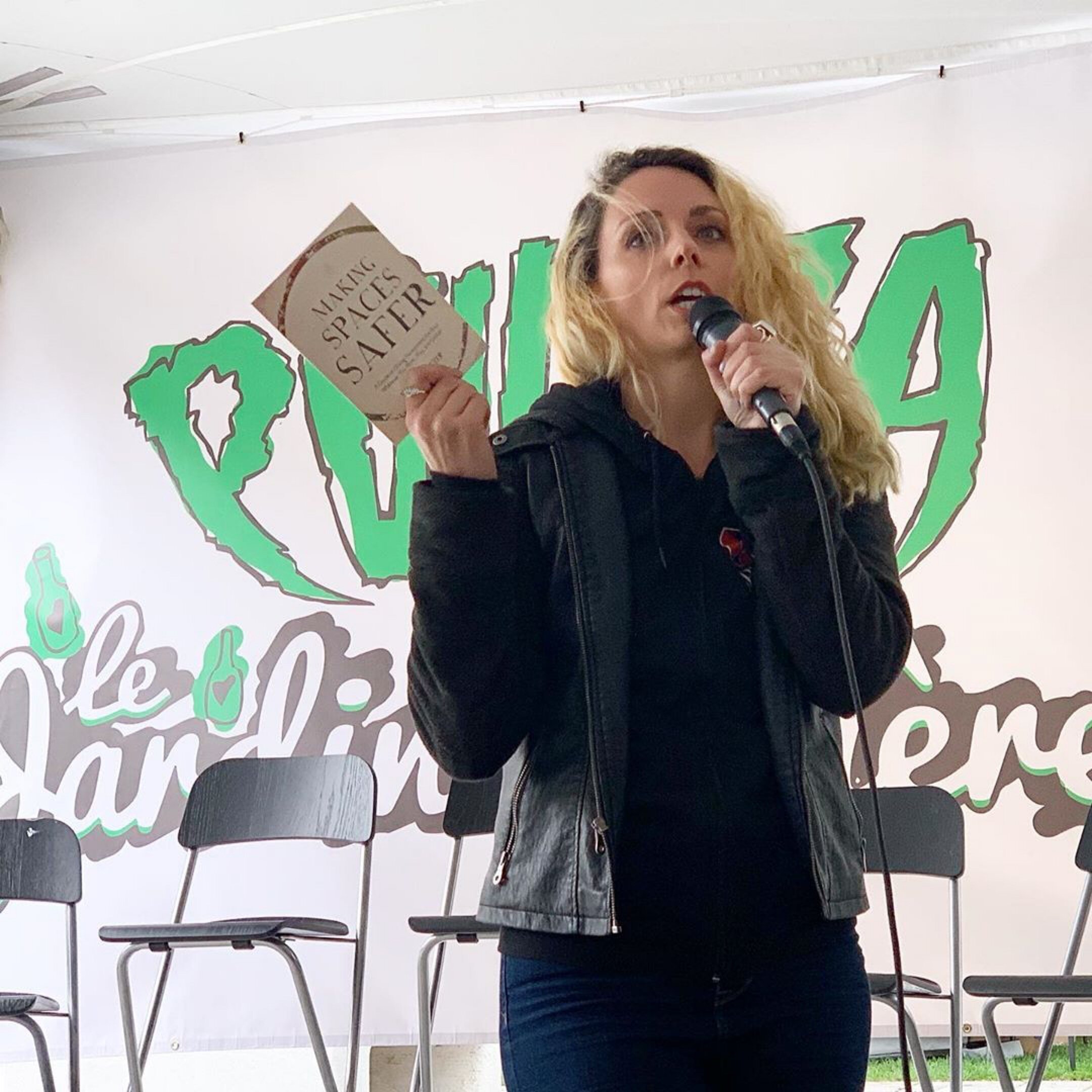
Shawna Potter is an Intimacy Coordinator, author, activist, punk singer, podcaster, public speaker, Hollaback! Baltimore founder, and more. She’s been featured in publications like The New York Times and The Washington Post.
To create this one of a kind, self-guided and self-paced, online curriculum version of her unique Safer Space Program training (later expanded into the essential guidebook, Making Spaces Safer), Shawna enlisted the help of Natalie Jurosky, a musician, educator, and community builder. As President of Scranton Girls Rock and Co-Founder of Women Who VYBE, she empowers women and youth through music, mentorship, and safe creative spaces.
Safer Spaces: Online Course
Learn how to make spaces safer in this self-guided online course.
-
Chapter 1: Why Safer Spaces Matter
-
Welcome!
What you can expect looking ahead and how to get the most out of this course.
-
Lesson 1: What is a Safer Space?
For us, it’s a verb. Let’s agree on our framework and learn more about the concept of safety.
-
Lesson 2: Recognizing Harassment
It looks a little different for everyone. Let’s get specific, raise our awareness, and reflect on what makes a space feel more welcome.
-
-
Chapter 2: Setting the Vibe
-
Lesson 1: Obvious Intentions
How and why to let people know what to expect before they ever come through your doors.
-
Lesson 2: Build the Culture
Consistency prevents hypocrisy. Here’s some everyday actions that can make a big impact.
-
Lesson 3: Setting the Vibe
Serve and represent your community by addressing internal biases, whether everyone’s on board or not.
-
-
Chapter 3: When Harm Happens
-
Lesson 1: Listening & Supporting
Learn how our words and behavior impact impact a victim of harassment - and how to make sure that impact is positive.
-
Lesson 2: The Three Options
The Safer Space Program’s victim-centered response method takes the guesswork out of what to say after a complaint of harassment.
-
Lesson 3: Let's Practice!
Your ability to use the skills you just learned out in the real world improves with, practice, role-playing, and talking through options.
-
-
Chapter 4: Intervention, Not Escalation
-
Lesson 1: Bystander Intervention
What to do when you’re not in charge or representing a space but still want to help someone being harassed.
-
Lesson 2: If You're Harassed
Tools, strategies, and suggestions
-
Lesson 3: We Keep Us Safe
What are some other things to consider when striving to keep our communities safer?
-
-
Chapter 5: Making Ourselves Safer
-
Chapter 6: Put It Into Action
Testimonials
-
Take this course and share it widely
As the instructional designer, I have seen firsthand how thoughtful and impactful Shawna’s work is. But most importantly, as a person who has lived in nightlife and community spaces my whole life, this course has made me feel more secure, more observant, and more grounded. Shawna already had decades of knowledge. I simply helped organize it. If you want to deepen your understanding and help create spaces where everyone feels welcome, take this course and share it widely. - Natalie Jurosky
-
I loved it!
The course is an excellent resource and venues could greatly benefit from employing your lessons. Also non venue related workplaces such as food service would definitely benefit. - Aaron Meda
-
Great vibe
Just so you know, your vibe when you present is great. It makes me feel safe listening to you and as if I could share things with you if needed. It’s a really good quality for a presenter to have, especially in this context, and it models it well for participants. - Denisha Brennan